Semaglutide’s evidence in metabolic dysfunction-associated steatohepatitis, or MASH, is more specific than a general claim that GLP-1 medicines help the liver. In the phase 3 ESSENCE trial, a particular regimen—semaglutide 2.4 mg injected under the skin weekly—improved two biopsy-based outcomes compared with placebo. The population had biopsy-confirmed MASH with moderate or advanced fibrosis, meaning liver scarring, rather than simply excess liver fat.
Those findings support an FDA-approved MASH indication for Wegovy injection through the accelerated approval pathway. They do not, by themselves, establish fewer liver transplants or deaths at 72 weeks. This analysis uses the indexed primary research abstracts and available official FDA material, not an examination of all full articles, protocols, or supplements. Its central question is what the measured improvements establish, and where medication identity and longer follow-up still matter.
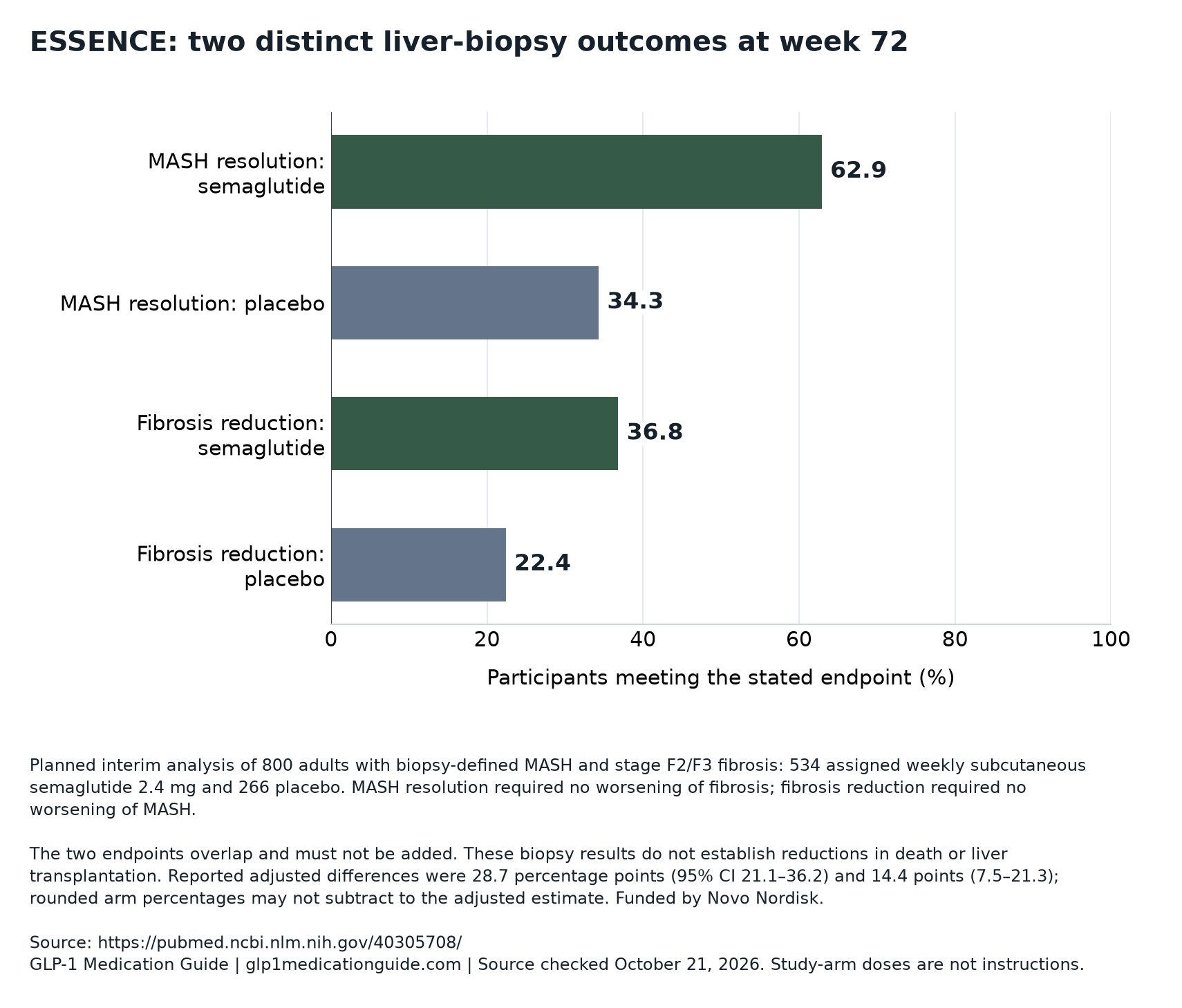
ESSENCE: two distinct liver-biopsy outcomes at week 72
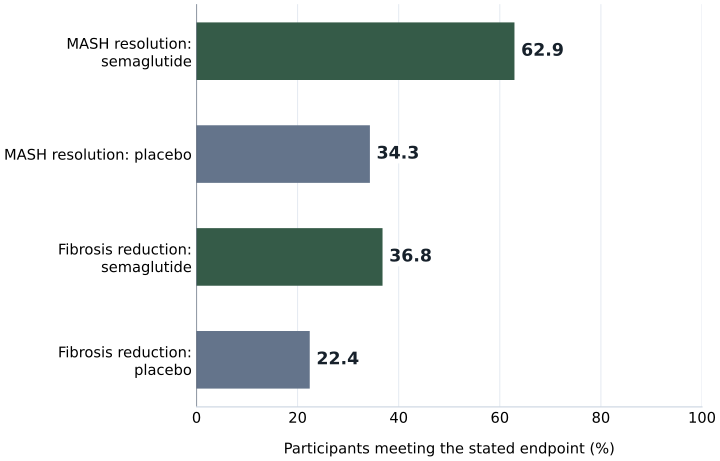
Planned interim analysis of 800 adults with biopsy-defined MASH and stage F2/F3 fibrosis: 534 assigned weekly subcutaneous semaglutide 2.4 mg and 266 placebo. MASH resolution required no worsening of fibrosis; fibrosis reduction required no worsening of MASH.
The two endpoints overlap and must not be added. These biopsy results do not establish reductions in death or liver transplantation. Reported adjusted differences were 28.7 percentage points (95% CI 21.1–36.2) and 14.4 points (7.5–21.3); rounded arm percentages may not subtract to the adjusted estimate. Funded by Novo Nordisk.
Source 1Download the source-labeled chart (PNG) · Download the data (CSV)
| Study group | Reported value |
|---|---|
| MASH resolution: semaglutide | 62.9 |
| MASH resolution: placebo | 34.3 |
| Fibrosis reduction: semaglutide | 36.8 |
| Fibrosis reduction: placebo | 22.4 |
Sections in this article
The disease stage defines the evidence
MASH involves liver injury and inflammation associated with fat accumulation. Fibrosis is the scar tissue that can develop as the liver responds to injury. These are related but distinct features: inflammation may improve without an accompanying reduction in established scarring, and a treatment’s effect on one cannot simply stand in for its effect on the other.
ESSENCE enrolled people with biopsy-defined MASH and fibrosis stage 2 or 3, commonly written F2 and F3. These represent moderate or advanced scarring before cirrhosis. The reported population therefore does not establish an equivalent benefit in people with only liver fat, earlier fibrosis, or cirrhosis. Matching the disease stage matters as much as recognizing the drug name.
FDA describes MASH as a disease that can progress to cirrhosis, worsening liver function, liver cancer, transplantation, or death. Many people have few symptoms before substantial damage. That helps explain why tissue findings matter scientifically, but it also makes symptom improvement an unreliable substitute for measuring disease. The study addressed a defined liver condition, not a broad wellness claim.
Source 1 Source 2How the 72-week comparison was constructed
ESSENCE is a multicenter, randomized, double-blind, placebo-controlled phase 3 trial. Investigators assigned 1,197 participants in a 2:1 ratio to weekly subcutaneous semaglutide 2.4 mg or placebo for a planned 240 weeks. Randomization supports a treatment comparison by reducing systematic differences at assignment; blinding limits the influence of knowing which treatment was received.
The published report covers a planned interim analysis of the first 800 participants at week 72, not final outcomes for all 1,197. Its two primary endpoints were MASH resolution without worsening fibrosis and fibrosis reduction without worsening MASH. Each endpoint therefore required improvement in one disease feature while protecting against deterioration in the other.
According to FDA’s account, both groups also received lifestyle changes, including dietary modification and increased physical activity, and participants were on stable doses of lipid-lowering, glucose-management, and weight-loss medications. The comparison was therefore semaglutide versus placebo within that care context, not injection treatment versus no care. Novo Nordisk funded the trial; that sponsorship is relevant context, alongside the design’s methodological strengths.
Source 1 Source 2Reading the biopsy results in percentage points
The first primary endpoint favored semaglutide: 62.9% met the definition of MASH resolution without worsening fibrosis, compared with 34.3% on placebo. The report’s estimated difference was 28.7 percentage points. Although subtracting the displayed rounded percentages gives 28.6, the published estimate—not a replacement calculation from rounded values—is the appropriate figure to preserve.
For fibrosis reduction without worsening MASH, the corresponding proportions were 36.8% and 22.4%, with an estimated difference of 14.4 percentage points. Both primary comparisons had reported P values below 0.001. The confidence intervals are more useful than statistical significance alone: they describe the precision of the estimated treatment differences rather than predicting one person’s response.
A practical numerical reading is that, per 100 comparable participants, the estimated between-group separation was about 29 additional people meeting the resolution endpoint and about 14 meeting the fibrosis endpoint. These are absolute percentage-point differences, not relative percentage reductions in future liver failure. Neither calculation turns a tissue response into a measured survival benefit.
| Outcome | Semaglutide versus placebo | Reported difference, percentage points (95% CI) |
|---|---|---|
| MASH resolution without worsening fibrosis | 62.9% versus 34.3% | 28.7 (21.1 to 36.2) |
| Fibrosis reduction without worsening MASH | 36.8% versus 22.4% | 14.4 (7.5 to 21.3) |
| Both MASH resolution and fibrosis reduction | 32.7% versus 16.1% | 16.5 (10.2 to 22.8) |
Why the response categories must not be added
The trial also measured a stricter joint outcome: both resolution of MASH and reduction in fibrosis. This occurred in 32.7% of the semaglutide group and 16.1% of the placebo group. The reported estimated difference was 16.5 percentage points, with a 95% confidence interval of 10.2 to 22.8. It was among the secondary outcomes included in the plan accounting for multiple statistical tests.
The three response categories overlap. A participant who experienced both resolution and reduced scarring could contribute to both primary endpoints as well as the joint endpoint. Adding 62.9% and 36.8% would therefore double-count some participants and would not yield an overall success rate. Likewise, the primary endpoints cannot be treated as competing categories that divide everyone neatly into separate groups.
The joint result answers a useful additional question: how often did both disease features improve together? It does not reveal every possible biopsy trajectory. The indexed abstract does not provide the complete distribution of unchanged, improved, and worsened findings. That limits attempts to reconstruct individual response patterns from the headline percentages.
Source 1Weight changed, but the pathway remains unresolved
Mean body weight declined 10.5% with semaglutide and 2.0% with placebo at week 72. The estimated between-group difference was −8.5 percentage points, with a 95% confidence interval from −9.6 to −7.4. These are group averages, not a statement that every participant lost the same amount or that a particular weight change guarantees a liver response.
The coexistence of weight loss and biopsy improvement does not establish how much of the liver effect came through weight reduction. FDA describes weight loss and potentially other incompletely understood mechanisms as possible contributors. Separating those pathways requires more than observing two favorable changes in the same randomized treatment group; the abstract does not establish a causal mediation analysis.
Bodily pain scores did not differ significantly between groups. That is important because tissue improvement and felt improvement are different outcomes. The result does not erase the biopsy benefit, but it prevents describing the study as demonstrating pain relief. A guide to keeping tests and results together can help organize those different kinds of information without treating them as interchangeable.
Source 1 Source 2Accelerated approval answers a different question from survival follow-up
Wegovy injection has an FDA-approved indication for adults with MASH and moderate-to-advanced fibrosis. Describing this use as still wholly investigational would miss that regulatory action. The approval used the accelerated pathway, which permits earlier approval for a serious condition based on a surrogate endpoint while requiring additional evidence to confirm clinically meaningful benefit.
A surrogate endpoint is a measurement used to stand in for outcomes such as how people feel, function, or survive. Liver histology—the microscopic assessment of biopsy tissue—provides direct evidence about inflammation and scarring. It is not itself a count of liver failure, transplantation, or death. Approval and uncertainty about those later outcomes can therefore coexist without contradiction.
FDA states that the trial will continue to 240 weeks to assess whether the tissue improvements translate into fewer deaths, transplants, and other liver-related events. The specific conclusion here concerns the 72-week analysis: it established biopsy improvements, not those later clinical benefits. The FDA announcement is also not a substitute for complete current prescribing information.
Source 1 Source 2Tolerability belongs beside the efficacy numbers
Gastrointestinal adverse events were more common with semaglutide in ESSENCE. The indexed abstract does not provide their counts, severity breakdown, or the treatment-discontinuation percentages. That supports a directional safety finding, not a precise estimate of how often a participant would experience symptoms or stop treatment because of them.
FDA’s approval announcement lists common effects including nausea, diarrhea, vomiting, constipation, and abdominal pain, alongside other adverse effects. It also identifies contraindications involving a personal or family history of medullary thyroid cancer, multiple endocrine neoplasia type 2, and known sensitivity to semaglutide or the product’s excipients. Those official safety statements should not be confused with ESSENCE-specific event rates.
Benefit and tolerability are separate dimensions. A favorable biopsy result does not mean treatment was symptom-free, while gastrointestinal symptoms do not establish that the liver response failed. Questions about adverse effects, medication history, and responsibility for follow-up can be organized using the GLP-1 visit preparation guide, without turning the trial dose into personal treatment instructions.
Source 1 Source 2SELECT and FLOW measured events in different populations
SELECT provides cardiovascular event evidence, but not in ESSENCE’s biopsy-selected population. It randomized 17,604 adults aged at least 45 with established cardiovascular disease, BMI of at least 27, and no diabetes to weekly injected semaglutide 2.4 mg or placebo. Over mean follow-up of 39.8 months, its primary composite occurred in 6.5% versus 8.0%; the hazard ratio was 0.80, with a 95% confidence interval of 0.72 to 0.90.
That hazard ratio describes the relative event hazard over follow-up, not a 20-percentage-point absolute reduction. SELECT also reported adverse events leading to permanent discontinuation in 16.6% versus 8.2%. FLOW instead enrolled 3,533 people with type 2 diabetes and chronic kidney disease, testing weekly injected semaglutide 1.0 mg against placebo. Its primary composite had a hazard ratio of 0.76, with a 95% confidence interval of 0.66 to 0.88.
FLOW’s median follow-up was 3.4 years after early stopping was recommended at a prespecified interim analysis; serious adverse events occurred in 49.6% versus 53.8%. Both trials were funded by Novo Nordisk. These studies strengthen outcome evidence for their respective populations, but neither supplies ESSENCE’s missing long-term liver result. A favorable composite also does not establish that every component improved separately.
| Trial and population | Studied injection regimen and follow-up | Primary outcome |
|---|---|---|
| ESSENCE: biopsy-defined MASH with F2/F3 fibrosis | 2.4 mg weekly; interim report at 72 weeks | MASH resolution and fibrosis reduction, each with a no-worsening condition |
| SELECT: established cardiovascular disease, overweight or obesity, no diabetes | 2.4 mg weekly; mean follow-up 39.8 months | Cardiovascular death, nonfatal heart attack, or nonfatal stroke |
| FLOW: type 2 diabetes and chronic kidney disease | 1.0 mg weekly; median follow-up 3.4 years | Kidney failure, at least 50% eGFR decline, or kidney-related or cardiovascular death |
An oral GLP-1 result is not evidence for the same liver indication
Medication identity includes the molecule, formulation, route, and tested regimen. ESSENCE studied injected semaglutide, not an oral product and not every medicine acting at the GLP-1 receptor. Milligram numbers across different molecules or routes are not a common scale of clinical potency. The medication-label guide explains how to keep those identifying details separate.
ATTAIN-1 illustrates the distinction. It randomized 3,127 adults with obesity without diabetes to an investigational oral orforglipron formulation at 6, 12, or 36 mg daily or placebo for 72 weeks. Its primary endpoint was percentage weight change, not liver histology. At 36 mg, mean weight change was −11.2%, compared with −2.1% on placebo; the other active-dose groups averaged −7.5% and −8.4%.
Gastrointestinal effects were most common, and adverse events led to discontinuation in 5.3%–10.3% of orforglipron groups versus 2.7% with placebo. Eli Lilly funded that study. These results deserve evaluation on their own terms, as discussed in the ATTAIN-1 oral GLP-1 analysis. Similar weight changes across separate trials do not establish equivalent MASH treatment effects or interchangeable products.
Source 1 Source 5What the evidence means for care documents and budgets
ESSENCE does not establish outcomes for a particular telehealth company, compounded preparation, or alternative formulation. FDA warns that unapproved GLP-1 products do not undergo its premarket review for safety, effectiveness, and quality. It has also received reports of dosing errors involving compounded injectable semaglutide, some requiring hospitalization, and notes that semaglutide sodium and acetate are different active ingredients from those in approved drugs.
Editorial interpretation: a useful care budget separates medication identity from the services surrounding it. Written terms can clarify what payment includes, who manages liver-related assessment, and how results reach the responsible clinician. Neither the ESSENCE abstract nor the FDA announcement supplies program prices, coverage guarantees, or evidence that a subscription improves liver outcomes.
For documentary comparisons, the Ro review and Form Health review are places to check written service and payment terms—not evidence that either offers the studied product or condition-specific care. The care-coordination guide offers a separate framework for tracking responsibility. These administrative questions matter, but they should remain distinct from the randomized treatment effect.
Source 1 Source 2 Source 6Questions about the evidence
Does MASH resolution mean the liver is completely normal?
Not necessarily. ESSENCE’s resolution endpoint required resolution of steatohepatitis without worsening fibrosis; it did not require disappearance of all scarring. The separate fibrosis endpoint and joint endpoint help distinguish reduced inflammatory disease from improvement in scar tissue. A response should therefore be described using the endpoint actually met, rather than as complete liver recovery.
Source 1Why did many placebo participants improve?
The placebo group was not an untreated group: FDA describes lifestyle changes and stable background medications in the trial. Its response rate shows why a controlled comparison is necessary. The accessible abstract does not determine how much placebo-group improvement came from those measures, disease fluctuation, or biopsy-related measurement variation, so assigning a specific explanation would exceed the evidence.
Source 1 Source 2Did ESSENCE prove that semaglutide prevents liver transplantation?
Not in the reported 72-week analysis. Its primary outcomes were biopsy-based. FDA describes the planned 240-week follow-up as testing whether improvements in inflammation and scarring translate into fewer deaths, transplants, and other liver-related events. The interim tissue results support treatment activity without supplying a numerical transplant-risk reduction.
Source 1 Source 2Can a compounded or oral product inherit the ESSENCE result?
No automatic transfer is justified. ESSENCE tested weekly subcutaneous semaglutide 2.4 mg. A compounded preparation lacks FDA premarket review, and an oral medicine may differ in molecule, absorption, exposure, and tested population. ATTAIN-1’s oral orforglipron results concern weight reduction in obesity, not proof of the same biopsy response in MASH.
Source 1 Source 6 Source 5Does accelerated approval mean there is little evidence?
It means the approval rests on a surrogate endpoint with additional confirmation required, not that there was no controlled evidence. ESSENCE was randomized, blinded, and placebo-controlled, with clear between-group biopsy differences. The remaining question is whether those tissue benefits produce clinically meaningful long-term outcomes, and how large those benefits are.
Source 1 Source 2Editorial assessment
ESSENCE provides persuasive randomized evidence that weekly injected semaglutide 2.4 mg improves defined liver biopsy outcomes over 72 weeks in MASH with F2 or F3 fibrosis. The estimated gains were larger for MASH resolution than for fibrosis reduction, and the joint response confirms that some participants improved in both domains. Gastrointestinal tolerability and the absence of significant bodily-pain improvement remain part of the result. FDA accelerated approval recognizes the tissue evidence while preserving the need to confirm longer-term clinical benefit. The soundest interpretation keeps disease stage, exact product, endpoint, and follow-up together rather than extending the finding to every GLP-1 formulation or care program.
Research access and limitations
This analysis relies on indexed primary-report abstracts and official FDA material. It does not reconstruct unavailable biopsy protocols, missing-data methods, detailed adverse-event tables, or individual response trajectories. The FDA approval announcement is not complete current prescribing information, and the 72-week ESSENCE report is not the final 240-week clinical-outcomes analysis.
Sources for this note
Scientific sources checked October 21, 2026. Earlier research and provider sources retain their dated histories below. Provider sources describe advertised offers; they do not independently establish quality of care.
- Phase 3 Trial of Semaglutide in Metabolic Dysfunction-Associated Steatohepatitis.Indexed original research abstract · Checked 2026-10-21
- FDA approves treatment for serious liver disease known as MASHOfficial FDA page read through web tool; historical approval announcement, not complete current labeling · Checked 2026-10-21
- Semaglutide and Cardiovascular Outcomes in Obesity without Diabetes.Primary research or official information · Checked 2026-10-21
- Effects of Semaglutide on Chronic Kidney Disease in Patients with Type 2 Diabetes.Primary research or official information · Checked 2026-10-21
- Orforglipron, an Oral Small-Molecule GLP-1 Receptor Agonist for Obesity Treatment.Indexed original research abstract · Checked 2026-10-21
- FDA — concerns with unapproved GLP-1 drugsRegulator guidance · Checked 2026-10-21