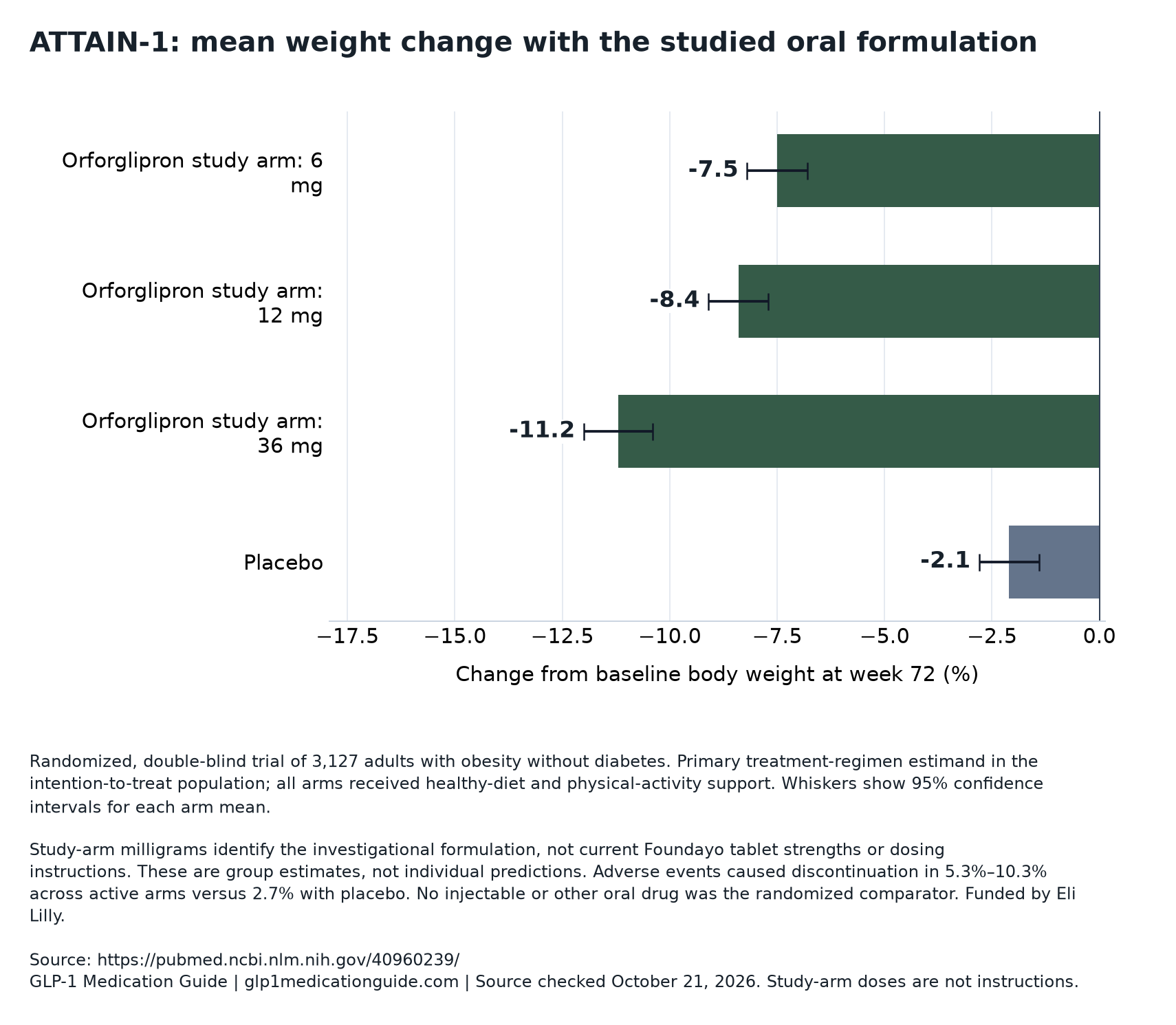
ATTAIN-1 provides a substantial piece of evidence for oral obesity treatment: 3,127 adults without diabetes were randomly assigned to once-daily orforglipron or placebo for 72 weeks. In the highest-dose investigational group, the primary analysis estimated an average body-weight reduction of 11.2%, compared with 2.1% with placebo. Those figures describe a specific formulation, study population, follow-up period, and statistical question—not a guaranteed outcome for anyone taking an oral GLP-1 medicine.
Medication identity is especially important here. Foundayo, the marketed orforglipron tablet, received initial US approval in 2026. Its official label explains how the investigational formulation supports the approved product, but the trial’s milligram doses are not current marketed tablet strengths. This analysis uses the indexed primary research abstracts and available official labeling and FDA material; it does not represent a review of every trial protocol, supplement, or full research article.
ATTAIN-1: mean weight change with the studied oral formulation
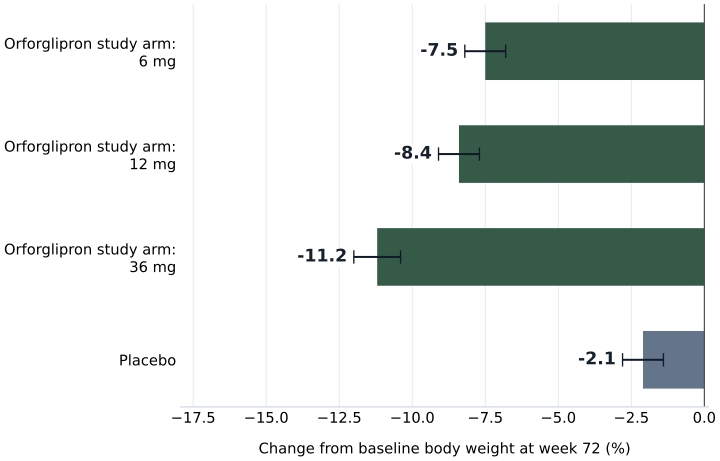
Randomized, double-blind trial of 3,127 adults with obesity without diabetes. Primary treatment-regimen estimand in the intention-to-treat population; all arms received healthy-diet and physical-activity support. Whiskers show 95% confidence intervals for each arm mean.
Study-arm milligrams identify the investigational formulation, not current Foundayo tablet strengths or dosing instructions. These are group estimates, not individual predictions. Adverse events caused discontinuation in 5.3%–10.3% across active arms versus 2.7% with placebo. No injectable or other oral drug was the randomized comparator. Funded by Eli Lilly.
Source 1Download the source-labeled chart (PNG) · Download the data (CSV)
| Study group | Reported value | 95% confidence interval |
|---|---|---|
| Orforglipron study arm: 6 mg | -7.5 | -8.2 to -6.8 |
| Orforglipron study arm: 12 mg | -8.4 | -9.1 to -7.7 |
| Orforglipron study arm: 36 mg | -11.2 | -12.0 to -10.4 |
| Placebo | -2.1 | -2.8 to -1.4 |
Sections in this article
What the randomized comparison actually tested
ATTAIN-1 was a multinational phase 3 trial funded by Eli Lilly. Participants were randomly allocated in a 3:3:3:4 ratio to once-daily oral investigational orforglipron at 6 mg, 12 mg, or 36 mg, or to placebo. Double blinding meant treatment assignments were concealed from participants and investigators. All groups received a diet and physical-activity intervention, so the comparison tested medication added to that support—not medication against doing nothing.
The official label identifies the same trial by registration number and provides eligibility details beyond the abstract’s shorthand description of obesity. Adults could have a body-mass index of at least 30, or a BMI from 27 to below 30 with a weight-related condition. Type 2 diabetes was excluded. Mean age was 45 years, mean baseline weight was 103.2 kilograms, and mean BMI was 37; 64% were female.
These details define the population behind the averages. The study included a range of adult ages and health conditions, rather than only otherwise healthy volunteers. Nevertheless, its principal comparison does not directly establish the same benefit in children, people with diabetes, or populations selected for a different disease.
Source 1 Source 2The primary analysis asked about assignment to treatment
The primary endpoint was percentage change in body weight from baseline to week 72. Percentage change expresses weight loss relative to each participant’s starting weight, allowing a more meaningful comparison across different body sizes than pounds alone. The intention-to-treat population included everyone randomized, rather than only people who completed treatment.
The treatment-regimen estimand specifies the effect being estimated: broadly, the outcome of assignment to the treatment strategy, including the consequences of treatment discontinuation. It is not simply the average among people who continuously took the medicine exactly as intended. This distinction matters because tolerability and persistence affect what a treatment strategy delivers.
A larger percentage presented under a different efficacy question should not replace this primary estimate. For interpreting the indexed ATTAIN-1 report, 11.2% is the highest-dose primary result. Comparing estimates without checking their estimands can make two descriptions of the same trial appear contradictory when they are answering different questions.
Source 1 Source 2Reading the dose groups without turning them into instructions
All three investigational-dose groups had greater estimated weight reductions than placebo. The table preserves the primary report’s dose names and confidence intervals. Negative changes indicate weight loss. Each comparison with placebo was statistically significant in the report, but statistical significance alone does not describe the size or everyday importance of the effect.
Subtracting the placebo mean from each active-treatment mean gives descriptive separations of 5.4, 6.3, and 9.1 percentage points. These are differences between percentage changes, not relative reductions in disease risk. For a hypothetical 100-kilogram starting weight, an 11.2% reduction represents 11.2 kilograms; that arithmetic illustrates scale rather than predicting an individual result.
A 95% confidence interval expresses uncertainty around the estimated group mean under the analysis assumptions. It is not a range containing 95% of individual weight-loss outcomes. The higher study dose had the largest mean reduction, but the abstract does not establish a personalized dose-response rule or a formal comparison between every pair of active doses.
| Investigational study arm | Mean weight change | 95% confidence interval |
|---|---|---|
| Orforglipron 6 mg daily | −7.5% | −8.2% to −6.8% |
| Orforglipron 12 mg daily | −8.4% | −9.1% to −7.7% |
| Orforglipron 36 mg daily | −11.2% | −12.0% to −10.4% |
| Placebo daily | −2.1% | −2.8% to −1.4% |
Response thresholds reveal variation behind the mean
In the investigational 36-mg group, 54.6% of participants achieved at least 10% weight loss, 36.0% achieved at least 15%, and 18.4% achieved at least 20%. Corresponding placebo proportions were 12.9%, 5.9%, and 2.8%. These results show that the treatment shifted more participants toward substantial weight reductions, while also showing that the largest reductions were not typical of everyone.
The thresholds overlap. Anyone losing at least 20% also qualifies for the 15% and 10% categories, so adding the three percentages would double-count participants. Read as hypothetical groups of 100, roughly 55 reached the 10% threshold in the highest investigational-dose group, including approximately 36 who reached 15% and 18 who reached 20%.
The absolute separation from placebo at the 10% threshold was 41.7 percentage points. That is a difference in the proportion reaching a weight-loss target, not a reduction in heart attacks or another clinical event. A threshold result also cannot identify beforehand which individual will respond or how quickly that response will occur.
Source 1Missing measurements and treatment stopping are different issues
The label reports that 22%–24% of active-treatment participants stopped trial medication in Trial 1, compared with 30% receiving placebo. Those figures include stopping for any reason. They should not be confused with the smaller proportions who stopped specifically because of adverse events.
At week 72, body-weight endpoint measurements were missing for 14%–16% of active-treatment participants and 24% of placebo participants. The label describes multiple imputation: a statistical procedure that fills in plausible missing values using information from the same randomized group, with different handling depending on whether missingness was possibly related to treatment.
Imputation preserves an analysis of the randomized population, but it cannot recreate measurements with certainty. Interpretation therefore depends partly on assumptions about people whose final weights were unavailable. The label’s efficacy table also has small numerical differences from the indexed report, including 11.1% rather than 11.2% in the highest group. Those presentations should remain separately identified rather than mixed into one apparently exact result.
Source 1 Source 2Foundayo is approved, but the investigational tablet names remain historical
Orforglipron is a small-molecule, nonpeptide GLP-1 receptor agonist: a drug that activates the human receptor used by the GLP-1 signaling system. Foundayo is its approved oral tablet product. The label lists marketed strengths of 0.8, 2.5, 5.5, 9, 14.5, and 17.2 mg—different numbers from the three investigational arms in ATTAIN-1.
The official label explicitly states that effectiveness and safety were established with an investigational formulation and presents those data using equivalent marketed dosages. That regulatory connection is not permission to substitute equal milligram amounts across formulations. The study doses identify research groups; they are not a conversion chart or a self-directed dosing schedule.
The practical documentary question is the exact active ingredient, product, formulation, and route on the prescription and dispensing label. The guide to reading a medication label offers a way to organize that check. An older abstract calling a medicine investigational describes its development context; it does not override the product’s subsequent US approval.
Source 1 Source 2Tolerability affected whether participants continued
In the indexed ATTAIN-1 report, adverse events caused treatment discontinuation in 5.3%–10.3% of participants across orforglipron groups, versus 2.7% with placebo. The abstract does not assign each percentage in that range to a named dose. Nor does it say every adverse-event discontinuation was gastrointestinal.
Gastrointestinal effects were the most common adverse events and were mostly mild to moderate. The official label adds pooled information from two weight-management trials, including participants with and without type 2 diabetes. In that broader pool, nausea occurred in 26%–35% across active groups versus 10% with placebo, and vomiting in 13%–24% versus 4%. Those are pooled-label findings, not ATTAIN-1-only rates.
The label reports severe gastrointestinal reactions in approximately 3% of treated participants versus 1% with placebo. Nausea, vomiting, and diarrhea were more frequent during dose escalation and decreased over time. This pattern helps explain the importance of tolerability, but does not mean persistent or severe symptoms are inevitable or unimportant. Preparing questions for a GLP-1 visit can keep symptom reporting and follow-up arrangements explicit.
Source 1 Source 2The label adds safety questions beyond common stomach effects
Foundayo carries a boxed warning concerning thyroid C-cell tumors. Other GLP-1 receptor agonists that activate rodent receptors have caused these tumors in rodents. Orforglipron is not pharmacologically active in rats or mice and did not produce tumors in those studies; whether the receptor-dependent findings are relevant to humans remains unknown. The drug is contraindicated with a personal or family history of medullary thyroid carcinoma or MEN 2.
The label also addresses pancreatitis, dehydration-related acute kidney injury, serious hypersensitivity, and gallbladder disease. In the pooled trials, acute kidney injury occurred in 0.2% of treated participants versus 0.05% with placebo. Gallstones occurred in 1% versus 0.7%, and acute gallbladder inflammation in 0.4% versus 0.3%. These uncommon outcomes should not be erased by describing the drug simply as safe.
Delayed stomach emptying can affect oral-medication absorption and creates additional questions around anesthesia and deep sedation. The label also includes pregnancy, contraception, and drug-interaction precautions. These issues extend beyond a weight-loss percentage; the guide to bringing upcoming procedures into care helps organize communication without assuming a universal medication-holding rule.
Source 2OASIS 4 offers context, not an oral-drug ranking
OASIS 4 studied a different oral medicine, semaglutide 25 mg, in 307 adults without diabetes. Participants had obesity or overweight with a complication and were randomized 2:1 to semaglutide or placebo plus lifestyle intervention. The trial lasted 71 weeks, but its coprimary weight endpoints were evaluated at week 64.
Estimated mean weight change was −13.6% with oral semaglutide and −2.2% with placebo: a difference of −11.4 percentage points, with a 95% confidence interval from −13.9 to −9.0. Gastrointestinal adverse events occurred in 74.0% versus 42.2%. Novo Nordisk funded the study. Different participants, timing, and analyses prevent these figures from proving superiority over orforglipron.
SURMOUNT-5 illustrates an actual direct comparison: participants were randomized between weekly subcutaneous tirzepatide and semaglutide. It did not compare oral products. Likewise, the separate ESSENCE analysis of liver-biopsy evidence concerns another endpoint and disease setting; evidence should follow the studied formulation and clinical question.
| Study and population | Comparison and timing | Reported weight findings |
|---|---|---|
| ATTAIN-1: 3,127 adults without diabetes | Investigational oral orforglipron versus placebo; week 72 | Highest investigational group −11.2%; placebo −2.1% |
| OASIS 4: 307 adults without diabetes | Oral semaglutide 25 mg versus placebo; week 64 endpoint in a 71-week trial | Semaglutide −13.6%; placebo −2.2% |
| SURMOUNT-5: 751 adults with obesity without diabetes | Weekly injected tirzepatide versus injected semaglutide; week 72 | Tirzepatide −20.2%; semaglutide −13.7% |
Separate medication evidence from service promises
ATTAIN-1 also found improvements versus placebo in waist circumference, systolic blood pressure, triglycerides, and non-HDL cholesterol. These findings broaden the picture beyond the scale, but they are not direct proof of fewer cardiovascular events, longer survival, or resolution of every weight-related illness. Nor do they establish how much benefit persists after treatment stops.
The same boundary applies to product substitutions. FDA states that compounded drugs are not FDA approved and do not undergo its premarket review for safety, effectiveness, and quality. An oral brand trial cannot validate a compounded product, another route, or a different formulation merely because its marketing uses similar GLP-1 language.
Editorial interpretation: when comparing care contracts, distinguish the medication being documented from the service being purchased. Trial results do not establish a telehealth provider’s outcomes, total costs, or follow-up quality. The Ro review and Form Health review can be starting points for checking documentary terms—not evidence that either provides the studied product or reproduces its results. Useful contract questions concern medication identification, included services, symptom-response arrangements, and cancellation terms.
Source 1 Source 2 Source 5Questions about the evidence
Does 11.2% describe what most people should expect?
It is an estimated group mean under the primary treatment-regimen analysis, not a personal forecast or necessarily the most common individual outcome. The responder thresholds show substantial variation: some participants reached much larger reductions, while others did not reach 10%. Baseline characteristics, treatment persistence, and individual response cannot be reduced to the mean alone.
Source 1Why does the trial mention 36 mg when Foundayo tablets use different strengths?
ATTAIN-1 used an investigational formulation. The approved label explains the relationship to the marketed formulation and presents trial data using equivalent marketed dosages. Equal milligram numbers across formulations should not be assumed to deliver equivalent exposure. The historical study-arm names are evidence identifiers, not instructions for selecting or converting a dose.
Source 1 Source 2Did ATTAIN-1 prove oral treatment works better than injections?
No. Its comparator was placebo, not an injectable medicine. OASIS 4 also used placebo, so placing its results beside ATTAIN-1 does not create a head-to-head trial. SURMOUNT-5 directly compared injected tirzepatide with injected semaglutide; its findings answer that injectable comparison, not whether an oral product is superior.
Source 1 Source 3 Source 4Were all treatment discontinuations caused by stomach symptoms?
No. The primary abstract reports discontinuation because of any adverse event, without labeling every event gastrointestinal. Stopping medication for any reason is a separate, larger category. The label’s pooled two-trial analysis says gastrointestinal reactions accounted for most adverse-reaction discontinuations, but those pooled findings should not be relabeled as ATTAIN-1-only results.
Source 1 Source 2Does approval settle every long-term safety and outcome question?
No. Approval establishes an authorized product and indication supported by regulatory review; it does not make uncommon harms impossible or turn weight change into proof of every downstream health benefit. The label retains significant warnings, and the 72-week primary weight endpoint does not establish lifelong effectiveness, outcomes after withdrawal, or equivalence of unapproved formulations.
Source 1 Source 2 Source 5Editorial assessment
ATTAIN-1 provides strong randomized evidence that the studied oral orforglipron strategies produced greater average weight loss than placebo over 72 weeks in adults without diabetes. Its most useful interpretation combines the primary mean estimate, overlapping response thresholds, discontinuation findings, and missing-data assumptions. Foundayo’s 2026 approval supplies the current product context, while its label—not the historical investigational milligram names—defines the marketed formulation. The evidence supports an oral treatment option, not a ranking against other drugs, an assurance of individual response, or an endorsement of any provider or compounded product.
Research access and limitations
The research comparisons here rely on indexed original-report abstracts, supplemented by the accessible official Foundayo label and FDA material. Full research protocols and supplements were not reviewed. Label analyses and pooled safety results are distinguished from ATTAIN-1 abstract estimates; no cross-trial superiority or individualized dose conversion is inferred.
Sources for this note
Scientific sources checked October 21, 2026. Earlier research and provider sources retain their dated histories below. Provider sources describe advertised offers; they do not independently establish quality of care.
- Orforglipron, an Oral Small-Molecule GLP-1 Receptor Agonist for Obesity Treatment.Indexed original research abstract · Checked 2026-10-21
- DailyMed - FOUNDAYO- orforglipron tablet, film coatedOfficial page retrieved in full · Checked 2026-10-21
- Oral Semaglutide at a Dose of 25 mg in Adults with Overweight or Obesity.Indexed original research abstract · Checked 2026-10-21
- Tirzepatide as Compared with Semaglutide for the Treatment of Obesity.Primary research or official information · Checked 2026-10-21
- FDA — concerns with unapproved GLP-1 drugsRegulator guidance · Checked 2026-10-21